

New York City Public Schools’ decision to prohibit generative AI for students through eighth grade is understandable. I even agree with much of the reasoning behind it.
Students need to think. They need to write, struggle with difficult ideas, wrestle with uncertainty, develop relationships, create things themselves, and learn how to solve problems without immediately handing the work to a machine.
But, banning AI is an overcorrection.
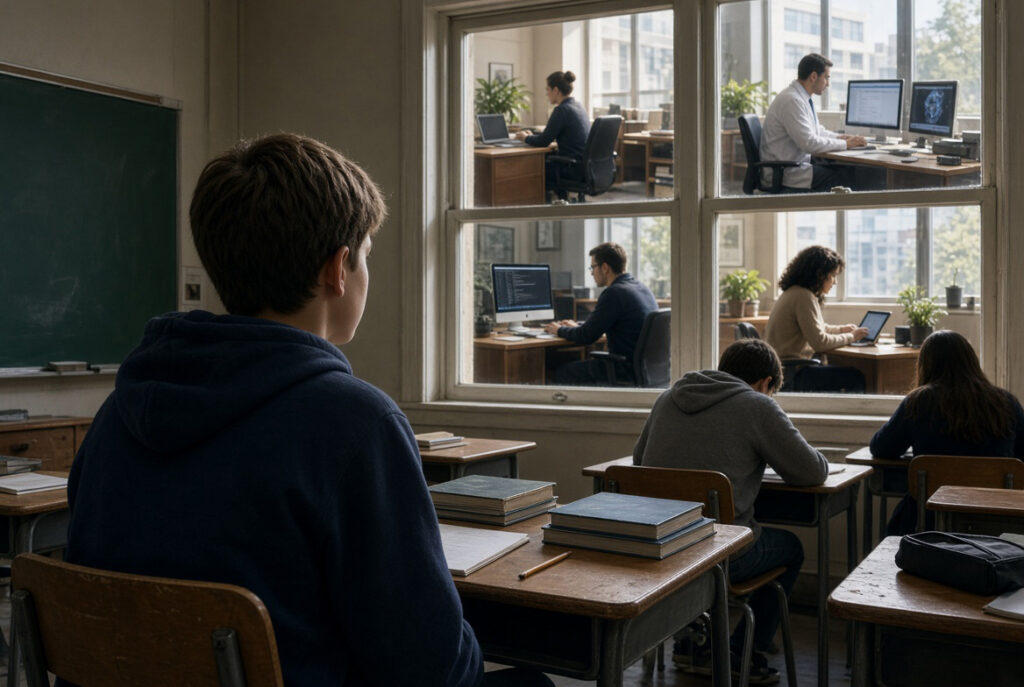
The challenge facing schools is no longer whether young people will encounter artificial intelligence. They already have, and AI will increasingly be embedded in the tools, workplaces, universities, and institutions they enter. Our responsibility is to teach them how to live and think in that world without surrendering their own capabilities to it.
That means there absolutely should be times when students do not use AI.
When students are learning something for the first time, particularly foundational concepts and thinking skills, there is enormous value in the struggle. They need opportunities to sit with not knowing, work through confusion, make mistakes, revise their thinking, and eventually incorporate that knowledge into their own cognitive framework. If AI continually removes that struggle, we risk producing students who can generate answers without developing the intellectual capabilities behind them.
But, protecting those moments is very different from removing AI altogether.
Students also need to learn how to use AI well. They need to understand what these systems can and cannot do, how they can be wrong, how they can influence our thinking, when they should be questioned, when they should not be used at all, and when they can legitimately expand human capability.
Most importantly, AI use in education should be explicit and transparent.
Instead of simply saying, “AI is banned,” an assignment should tell students what kind of AI use is appropriate. Perhaps, AI cannot be used at all because the purpose is to develop a foundational skill. Perhaps, it can be used for brainstorming but not writing. Perhaps, students can use it throughout the process but must document what they used, what they changed, what they rejected, and why.
That teaches judgment.
A sweeping prohibition risks doing something else: driving AI use underground. Students will still encounter these tools, but instead of learning to use them openly with teachers who can guide them, they may learn to hide their use. Then, we lose the opportunity to teach the very habits we should be developing: transparency, verification, responsibility, agency, and critical judgment.
The goal should not be to create students who can function only without AI. Nor should it be to create students who cannot function without it.
We should be developing young people who know the difference.
They should know when to think for themselves, when to struggle, when to ask for help, when AI can make them more capable, and when using it would take away the very thinking they need to develop.
The future of education should not be AI everywhere.
But, it should not be AI nowhere, either.
It should be human thinking first, with AI used deliberately, transparently, and only where it genuinely helps students become more capable.